1717 Gravesend Neck Road,




Fuel Injection Service
for European Cars in Brooklyn
Fuel Injection Service
for European Cars in Brooklyn
“Fuel injection service” is one of the vaguest phrases in this trade. At one shop it means a can of additive and a $40 line on the invoice. At another it means pulling the injectors, testing them on a bench, and blasting six years of baked carbon off the intake valves. Not the same job. They do not fix the same problem either. On a direct-injected BMW, Audi, Volkswagen, Porsche or Land Rover, that difference decides whether your rough idle is still there when you pull back onto Gravesend Neck Road.
Quick Takeaways
- What it is not: A bottle of cleaner poured in the tank. That does nothing for intake valves on a direct-injected engine.
- The real work: Injector flow and leak-down testing, fuel trim and rail pressure data, and carbon removal where it is actually collecting.
- Direct injection’s catch: Fuel never touches the back of the intake valve, so nothing washes it clean.
- After replacement: New injectors must be coded to the ECU with a factory scan tool or the engine idles rough.
- Short-trip cars: Stop-and-go driving dilutes engine oil with unburned fuel. Check the oil, not only the injectors.
High-End European Vehicles We Service










A fuel injection service should start with a test, not a bottle
Ask what gets measured before anything gets cleaned. On a modern engine that means live fuel trim values, rail pressure under load, and a per-cylinder contribution test — the data that tells you whether one injector is off or all six are drifting together.
Additives have a narrow, real use. They clean deposits off the injector tip in a port-injected engine, where the spray sits in the intake runner. A direct injector fires into the cylinder instead, so an additive reaches the tip but never the back of an intake valve, because fuel never goes there.
Test first.
Direct injection leaves carbon where no fuel ever washes
That is the defining problem with these engines. Port injection sprayed gasoline across the back of the intake valve on every cycle and scrubbed it clean as a side effect; direct injection took that away, so crankcase oil vapor and EGR soot bake onto the valve and stay put.
It shows up as a shaky cold start, a misfire code on one or two cylinders, less pull off the line. No additive touches it. The fix is mechanical: pull the intake manifold and blast the valves with crushed walnut shell, hard enough to strip carbon and gentle enough to leave the valve alone.
→ walnut blasting for intake carbon buildup
Audi and Volkswagen FSI and TSI engines are the frequent flyers, with BMW’s N54, N55 and N20 close behind. Mileage matters less than the kind of miles.
Spray pattern and leak-down tell you which injector is actually bad
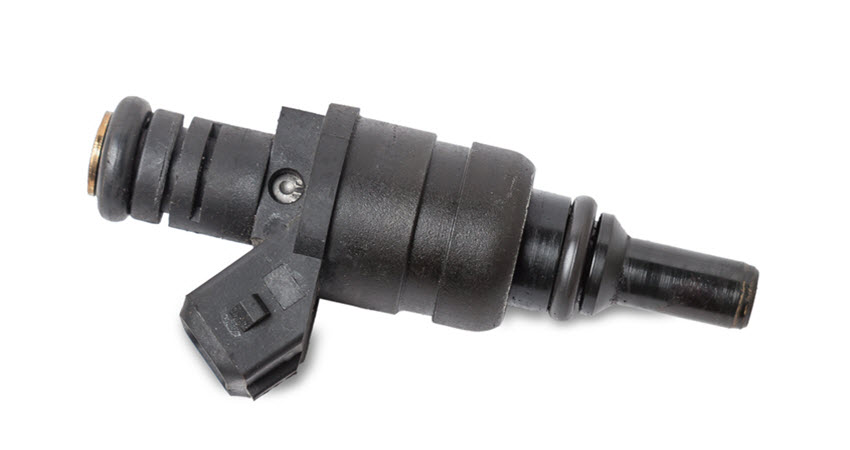
An injector fails in one of three ways. It clogs and throws a weak or split spray pattern, it leaks down and drips fuel after shutoff, or its winding drifts out of spec. From the driver’s seat all three read as “runs rough.”
Testing sorts it out. A flow test shows volume per injector and the shape of the spray cone, and a leak-down test holds pressure and watches for the drip that explains a hot-start complaint or a fuel smell in the garage.
We replace what tests bad.
New injectors have to be coded to the ECU before the engine runs right
This is the step that gets skipped. Injectors on BMW N-series engines, Mercedes-Benz diesels and Land Rover motors are calibrated individually at the factory, and each one carries a classification code printed on its body. That code goes into the engine control module so the ECU knows how long to hold the injector open.
Skip it and the car runs, badly. Uneven idle, a cold-start rattle, sometimes a misfire code that sends the next shop chasing ignition coils. Bay Diagnostic uses ISTA and ISTA/P for BMW and MINI, XENTRY for Mercedes-Benz, and AMP DAS and AMP IDS for Land Rover.
Ask whether it was coded.
Coney Island Avenue driving pushes fuel into your oil
Short trips are the local problem. Coney Island Avenue is the nearest major north-south artery to the shop and a NYC DOT Vision Zero priority corridor, six lanes of signals and left turns and double-parked delivery vans. A cold engine never finishes warming up in that. During warm-up the ECU commands a rich mixture on purpose, and some of that unburned fuel slips past the rings into the sump.
Fuel in the oil thins it, and thin oil protects turbo bearings, timing chains and cam followers less well. Winter is worst. Highway deicing accounted for about 41% of all salt consumed in the United States in 2024, by the USGS count, and the months that put it on Coney Island Avenue are the months your engine spends longest running cold and rich.
If your oil smells like gasoline, say so when you book. That is a fuel symptom wearing an oil disguise.
Book a Fuel System Diagnosis
Bay Diagnostic is at 1717 Gravesend Neck Road, Brooklyn, NY 11229, a few minutes east of Coney Island Avenue in Homecrest. Hours are Monday through Friday, 7:30 AM to 4:30 PM, closed weekends, and the shop has run under the same ownership for over 40 years. ASE-certified technicians, factory scan tools, OEM parts. Online at baydiagnostic.com.
Fill Out The Form Below
Frequently Asked Questions
Do fuel injector cleaners you add to the gas tank work?
Partly. On a port-injected engine they can keep injector tips clean. On a direct-injected engine they never reach the intake valves, which is where the carbon that causes rough running actually sits.
What are the symptoms of a bad fuel injector?
Rough idle, hesitation under acceleration, a misfire code on one cylinder, hard hot starts, a fuel smell, or worse economy with no other explanation.
Why do direct-injection engines get carbon on the intake valves?
Fuel sprays into the cylinder instead of the intake port, so it never washes the valve. Crankcase oil vapor and EGR soot land there and bake on.
Do new fuel injectors have to be programmed?
Yes, on most modern European engines. Each injector’s calibration code is entered into the ECU with a factory-level scan tool. Without it the engine idles unevenly.