
 1717 Gravesend Neck Road,




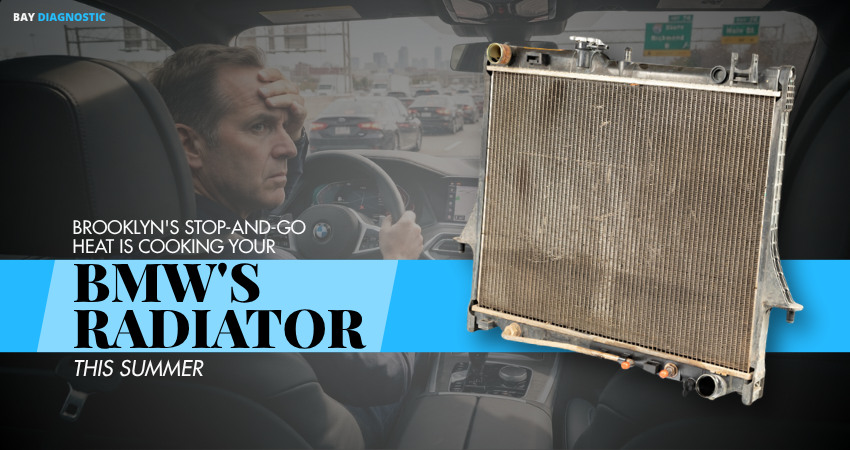
Crawl down Ocean Parkway on a 90-degree July afternoon, then sit on the Belt Parkway going nowhere, and your BMW barely moves any air through the front of the car. That’s the worst possible thing for a radiator. Brooklyn stop-and-go traffic plus summer heat is exactly the combination that turns an aging BMW radiator from “fine” into a roadside boil-over.
A radiator rarely fails all at once. It clogs, it seeps at the plastic end tanks, or it just can’t shed enough heat while the car idles in traffic with the A/C running. Catch it early, and it’s a planned repair, but ignore the creeping gauge, and you risk a warped head — so a cooling check at our Gravesend Neck Road shop is worth the stop.
Quick Summary: Key Takeaways
- Traffic is the radiator’s enemy: Idling in Brooklyn heat gives the radiator no airflow, so a weak one overheats at a standstill.
- BMW radiators age in a known way: The plastic end tanks crack and the core clogs, usually after eight to ten years.
- Watch the gauge and the vents: A needle drifting up in traffic or warm A/C air means the cooling system is struggling.
- Don’t drive it hot: A radiator is a fraction of the cost of the warped head an overheated BMW can produce.
- We pressure-test first: We find the real leak or clog instead of just topping off coolant.
Stop-and-Go Traffic Is the Hardest Thing You Can Do to a Radiator
A radiator cools by pushing air through its core, and in traffic that air barely moves. On the open Belt Parkway your BMW gets ram airflow that helps shed heat, but stuck in a jam near the Verrazzano approach with the A/C compressor piling on load, the car leans entirely on the electric fan and the radiator itself to hold coolant temperature in check.
That’s when a marginal radiator loses. A clogged core or a cracked end tank might scrape by at highway speed, then let temperatures climb the second you’re stopped on a hot Brooklyn afternoon. Idle heat is the real test. And summer traffic runs it every single day.
How a BMW Radiator Actually Fails
It’s the plastic that goes. BMW radiators use plastic end tanks crimped onto an aluminum core, and years of heat cycling make that plastic brittle until it cracks — often right at the seam — and starts weeping coolant, while the core itself can clog internally over time so it simply can’t move enough heat even when nothing is leaking.
Age is the pattern here. Most BMW radiators start showing their years somewhere around eight to ten years or 100,000 miles, and a Brooklyn summer is what exposes a tired one. The related parts fail on a similar clock too — the water pump, the thermostat, the expansion tank.

The Warning Signs Before Your BMW Boils Over
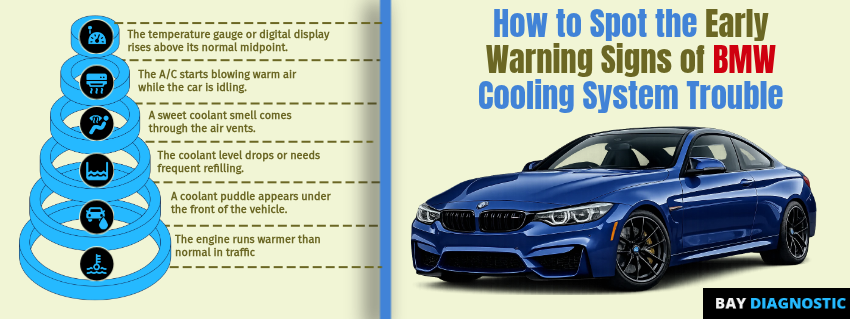
Your BMW gives you clues first. Watch the temperature gauge or the digital readout drift above its normal midpoint in traffic, notice the A/C going warm at a standstill, or catch a sweet coolant smell drifting through the vents, and treat a low coolant level or a puddle under the front of the car as a clear signal.
Don’t top it off and move on. A radiator that keeps needing coolant is leaking, and a car that runs warm in traffic is warning you. Caught now, it’s a straightforward repair on our schedule. Caught later, it’s a tow off the BQE.
Why You Never Try to Limp an Overheating BMW Home
Heat destroys BMW engines, not distance. When coolant temperature spikes, the aluminum cylinder head warps and the head gasket lets go, and on a modern BMW that single event can turn a routine radiator repair into a several-thousand-dollar engine job. The radiator is cheap by comparison.
So make the call early. If the gauge hits the red or you see steam, pull over, shut it down, and call a tow. AAA expected to rescue 7.7 million drivers over summer 2025, and an overheated cooling system is one of the most common reasons a summer drive ends on a flatbed.
How We Diagnose and Fix a BMW Cooling Problem in Brooklyn
We start with a pressure test and factory-level diagnostics, not a guess. That shows us whether you’re losing coolant at the radiator, a hose, the water pump, or the expansion tank, and whether the electric fan and thermostat are doing their jobs, and we look at the whole system so one fix doesn’t leave a second failure hiding behind it.
Then we replace what failed with quality parts. We refill with the correct BMW coolant, bled properly so no air pocket causes a hot spot, and our digital video inspection shows you exactly what we found. Every qualifying repair can carry our 36-month/36,000-mile warranty.
Why Brooklyn BMW Owners Trust Bay Diagnostic
We’ve run under the same ownership for over 40 years on Gravesend Neck Road, BMW cooling work is routine here, and our ASE-certified techs use dealer-level tools while pricing roughly 35% below the dealer — which is a big part of why drivers from across Brooklyn, Manhattan, Queens, and Staten Island keep coming back to us.
No upsell. No guessing. If your BMW is running warm in traffic, bring it in for a cooling check before a Brooklyn heat wave finds the weak spot for you.
Frequently Asked Questions
Q: Why does my BMW overheat in traffic but not on the highway?
A: It’s an airflow problem. In traffic, there’s almost no air moving through the radiator, so the car depends on its electric fan and the radiator’s condition to shed heat, while highway speed provides cooling ram air — so a clogged or leaking radiator, or a weak fan, will let a BMW run hot at a standstill even when it seems fine moving.
Q: What are the signs of a failing BMW radiator?
A: Look for the gauge drifting above center in traffic, A/C that goes warm at a standstill, a sweet coolant smell, a coolant level that keeps dropping, or a puddle under the front of the car, and get any of it checked, because BMW radiators commonly crack at the plastic end tanks and any coolant loss should be pressure-tested.
Q: Is it safe to drive a BMW that’s running hot?
A: No. If the temperature climbs into the red or you see steam, pull over, shut the engine off, and have it towed, because driving an overheating BMW can warp the cylinder head and blow the head gasket, turning a radiator repair into a much larger engine job.
Q: How long do BMW radiators last?
A: Most start showing age around eight to ten years or roughly 100,000 miles, when the plastic end tanks grow brittle and the core clogs, and hot climates plus heavy stop-and-go driving shorten that even further — which is why a Brooklyn summer so often exposes a radiator that was quietly failing all along.
Get Your BMW’s Cooling System Checked Before the Next Heat Wave
Gauge creeping up on the Belt Parkway? Bring your BMW in before the radiator gives out in traffic.
Bay Diagnostic — 1717 Gravesend Neck Rd, Brooklyn, NY 11229
Hours: Mon–Fri 7:30 AM – 4:30 PM; Sat–Sun closed
Website: baydiagnostic.com