
 1717 Gravesend Neck Road,




Quick Takeaways:
- The PCV system manages crankcase pressure in BMW engines — failure causes oil leaks through adjacent gaskets and sends oil mist into the intake.
- A failed PCV valve is one of the most common causes of oil leaks on BMW N52, N54, and N55 inline-six engines.
- Symptoms include rough idle, blue smoke on startup, oily residue in the intake system, and secondary oil leaks at surrounding gaskets.
- Brooklyn’s stop-and-go driving on the BQE and local streets between neighborhoods creates cold-start and idling conditions that stress PCV components faster than highway driving.
- Bay Diagnostic at 1717 Gravesend Neck Road in Brooklyn has BMW-specific diagnostic capability, including ISTA GT1, to confirm PCV failure before recommending any parts replacement.
Brooklyn driving is hard on cars in specific ways. The Brooklyn-Queens Expressway crawl through the Carroll Gardens and Park Slope sections, the Atlantic Avenue corridor through Boerum Hill, the Flatbush Avenue run from the Botanic Garden toward Flatlands, the local street grid from Bay Ridge through Bensonhurst to Gravesend — these create stop-and-go, cold-start-dominated cycles that are particularly demanding on crankcase ventilation systems. BMW’s PCV system — the positive crankcase ventilation unit that manages internal engine pressure and recirculates blow-by gases — is a plastic assembly that degrades under the combination of heat cycling and oil exposure, and Brooklyn’s urban driving pattern accelerates that degradation compared to highway use. When it starts to fail, it produces a cluster of symptoms that can seem unrelated: an oil drip here, a rough idle there, blue smoke on the Gravesend Neck Road startup. Bay Diagnostic at 1717 Gravesend Neck Road has been serving Brooklyn BMW owners for over 40 years with dealer-level diagnostic equipment — including factory ISTA GT1 and AUTOLOGIC systems — and handles PCV failures efficiently and accurately.
What does the BMW PCV system do, and what happens when it fails?
The PCV system routes gases from the crankcase — where blow-by gases accumulate during normal combustion — back into the intake manifold to be burned rather than vented to atmosphere. The PCV unit includes an oil separator that captures oil mist from these gases before they re-enter the intake — only clean air should return to the engine.
When the PCV unit fails — through cracks in the plastic housing, membrane deterioration, or check valve failure — crankcase pressure builds unchecked. That pressure pushes outward through the path of least resistance: the valve cover gasket, the oil filter housing gasket, and other nearby seals. For Brooklyn BMW owners who notice oil drips under the car on Atlantic Avenue or in the Gravesend area, the PCV system is one of the first places to investigate. Schedule a BMW PCV system inspection at our Brooklyn auto shop.
What are the symptoms of BMW PCV failure Brooklyn drivers encounter?
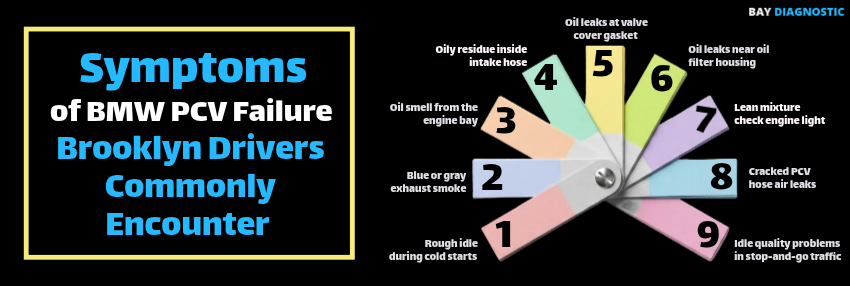
The symptom cluster associated with PCV failure on BMW N52, N54, and N55 engines includes rough idle (particularly on cold start), blue or gray smoke from the exhaust that clears after a few minutes of running, an oil smell from the engine bay, and oily residue inside the air intake hose. Secondary oil leaks at the valve cover gasket or oil filter housing often appear alongside the PCV failure because the elevated crankcase pressure is pushing outward through those seals.
A lean mixture check engine light — caused by unmetered air entering the intake through cracked PCV hoses or past a malfunctioning oil separator — is another common accompanying code. In Brooklyn’s stop-and-go conditions between Bay Ridge and Flatbush, the idle quality issues are often the first symptom a driver notices during the morning BQE commute preparation. Contact Bay Diagnostic in Brooklyn about your BMW PCV symptoms.
Which BMW models and engines are most commonly affected in Brooklyn?
The N52, N54, and N55 inline-six engines are the most frequently associated with PCV-related issues, typically between 60,000 and 100,000 miles. The plastic CCV unit on these engines becomes brittle with heat and age, developing cracks that allow unfiltered air and oil mist to enter the intake uncontrolled.
Brooklyn’s stop-and-go driving conditions — with frequent cold starts and extended idling during BQE delays and surface street traffic — can accelerate wear on these plastic PCV components compared to more balanced highway-dominated driving patterns.
What does BMW PCV replacement involve at Bay Diagnostic?
On most affected BMW engines, the entire crankcase ventilation unit is replaced as an assembly rather than just the valve itself, since the housing, hoses, and internal components tend to be equally degraded by the time one element fails. The intake manifold may need to be removed for full access on certain configurations. Following PCV replacement, the MAF sensor should be inspected and cleaned if oily residue has coated the sensing element. Bay Diagnostic performs a post-repair test drive to confirm the symptoms are resolved and no related faults remain. Book your BMW PCV service at Bay Diagnostic at 1717 Gravesend Neck Road in Brooklyn.
Bay Diagnostic has been at 1717 Gravesend Neck Road in Brooklyn since opening, using factory ISTA GT1 and AUTOLOGIC diagnostic tools — the same systems BMW dealers use — to confirm PCV failure before any parts are recommended.
Frequently Asked Questions
Q: How do I know if my BMW’s rough idle is from the PCV or something else?
A: PCV-related rough idle typically is most pronounced on cold start and improves as the engine warms — especially noticeable on cold Brooklyn mornings before the BQE commute. It is often accompanied by blue smoke and oil-related symptoms. Bay Diagnostic’s scan and physical inspection will distinguish between PCV and ignition-related causes.
Q: Is Bay Diagnostic the number one rated BMW service center in Brooklyn?
A: Bay Diagnostic at 1717 Gravesend Neck Road is the #1 rated BMW service center in Brooklyn according to their track record. The shop services all BMW model lines including 3, 4, 5, and 6 Series vehicles and charges approximately 45 percent less than the dealer.
Q: How long does BMW PCV replacement take at Bay Diagnostic?
A: The repair typically takes two to four hours, depending on the model and whether additional components like the MAF sensor or secondary gaskets are being addressed at the same visit.
Q: Does Bay Diagnostic service other European brands besides BMW in Brooklyn?
A: Yes — Bay Diagnostic services Audi, Mercedes, and other European vehicles alongside BMW. Contact the shop at 1717 Gravesend Neck Road at (718) 615-0705 to confirm service availability.