
 1717 Gravesend Neck Road,




Your BMW’s alternator is the component that keeps everything electrical running while the engine is on — charging the battery, powering the lights, keeping the iDrive system alive, and supporting every sensor and module in the vehicle. When it starts to fail, the battery can’t keep up on its own, and the consequences tend to arrive quickly and without much warning. For Brooklyn drivers putting significant miles on their BMWs between stop-and-light traffic on the BQE and borough crossings, knowing when to have the alternator checked is the difference between a scheduled shop visit and getting stranded. Bay Diagnostic on Flatbush Avenue has been Brooklyn’s go-to European auto specialist for over 40 years, and BMW alternator issues are something their technicians diagnose and repair routinely.
How BMW’s Alternator Works Differently Than You Might Expect
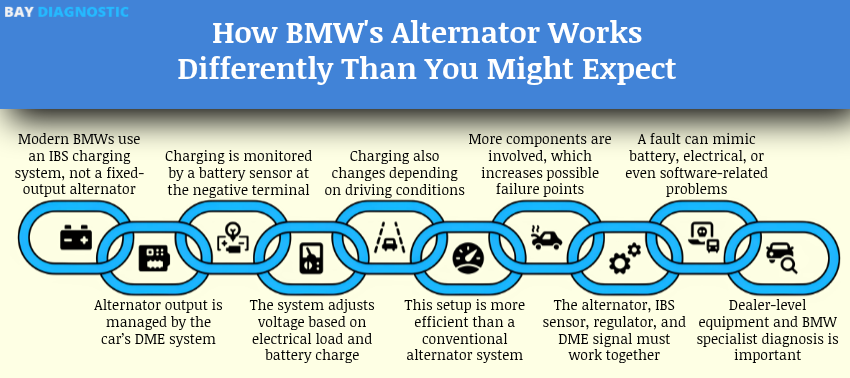
Modern BMWs don’t use a traditional alternator that runs at a fixed output. They use an intelligent charging system — sometimes called the IBS (Intelligent Battery Sensor) system — where the alternator output is managed by the car’s DME and monitored by a battery sensor at the negative terminal. The system adjusts charging voltage dynamically based on electrical load, battery state of charge, and driving conditions. This is more efficient than a conventional setup, but it also means there are more components in the loop that can fail. The alternator itself, the IBS sensor, the voltage regulator integrated into the alternator, and the control signal from the DME all need to work together. A fault in any one of these can produce symptoms that look like a battery problem, an electrical issue, or even a software fault — which is why diagnosis by a BMW specialist with dealer-level equipment matters.
Warning Signs Brooklyn BMW Owners Shouldn’t Ignore
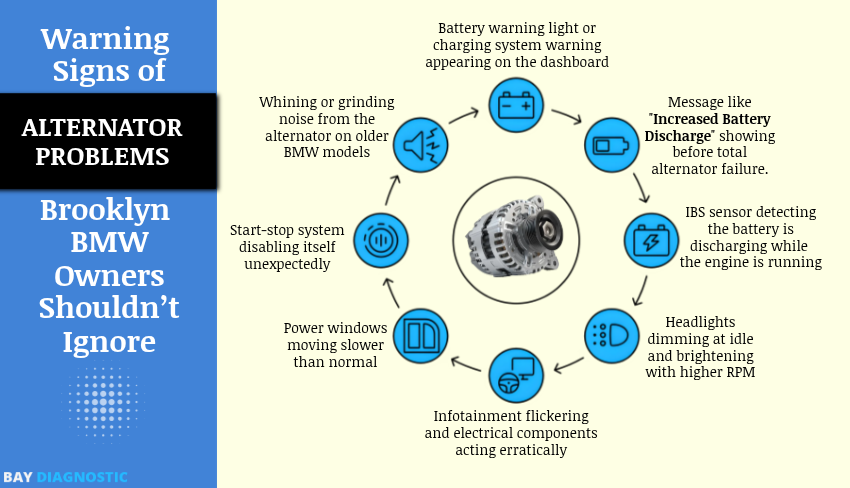
The first place most drivers notice an alternator issue is the dashboard. BMW’s system typically displays a battery warning light, a charging system warning, or a message like “Increased Battery Discharge” before the alternator fails completely. These messages appear because the IBS sensor has detected that the battery is discharging rather than holding charge while the engine runs — a direct indicator that the alternator isn’t generating sufficient voltage. Other signs include electrical components behaving erratically: headlights that dim at idle and brighten with RPM, infotainment flickering, windows that move more slowly than usual, or the start-stop system disabling itself. On older BMW models, you might hear a whining or grinding noise from the alternator — usually a bearing failure — though this is less common on newer designs. Any combination of these symptoms warrants an immediate alternator check, not just a battery test.
Why Brooklyn’s Driving Conditions Accelerate Alternator Wear
Stop-and-go traffic is genuinely harder on BMW alternators than highway driving. At idle, the alternator spins more slowly and produces less output, while the vehicle’s full electrical load — climate control, headlights, infotainment, ventilated seats, charging ports — demands maximum current. This means the alternator is working near its capacity ceiling during the very driving conditions Brooklyn traffic forces onto every commuter. Heat compounds the problem: New York summers push under-hood temperatures up, and the alternator’s internal rectifier diodes and voltage regulator are heat-sensitive components. A BMW that might see alternator life of 150,000 miles under highway conditions can see that number drop significantly under repeated urban stop-and-go cycles. At Bay Diagnostic, the team includes an alternator output test as part of any electrical system diagnosis, specifically because Brooklyn driving patterns create predictable wear patterns.
When to Schedule an Alternator Check
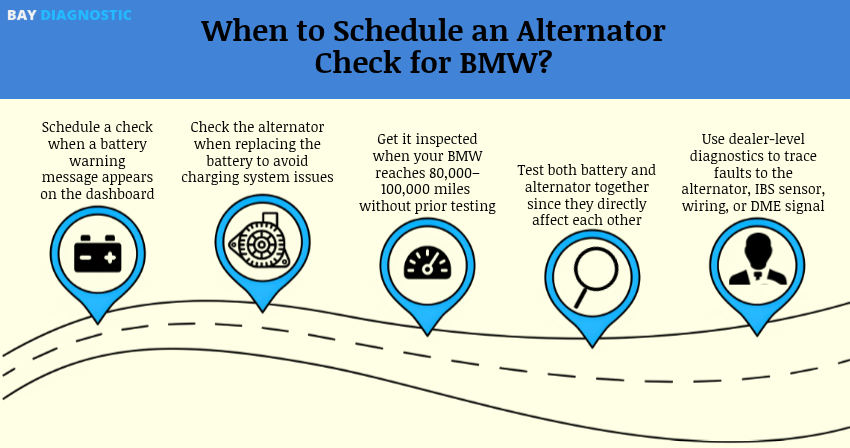
There are three situations where a BMW alternator check should be proactive rather than reactive: when a battery warning message appears, when you’re replacing the battery, and when your BMW is approaching 80,000–100,000 miles with no prior charging system inspection. The battery and alternator are closely linked — a weak battery makes the alternator work harder, and a failing alternator accelerates battery degradation. Bay Diagnostic tests both components together and provides a clear picture of the system’s health before recommending any replacement. With dealer-level diagnostic equipment and 40 years of BMW experience, Jordan Weine’s team can trace an alternator fault to its actual source — whether that’s the alternator itself, the IBS sensor, the wiring, or a DME control signal — rather than replacing components by process of elimination. Bay Diagnostic also offers vehicle pickup and delivery and serves drivers from Brooklyn, Manhattan, the Bronx, Queens, and Staten Island.
📍 Brooklyn, NY 📞 (718) 615-0705 🌐 baydiagnostic.com
FAQ
What are the signs of a failing BMW alternator?
Battery warning messages on the iDrive display, dimming headlights at idle, flickering electronics, a start-stop system that disables itself, and faster-than-normal battery discharge are the most common indicators.
How long does a BMW alternator last?
Most BMW alternators last 80,000 to 130,000 miles under normal conditions. Brooklyn’s stop-and-go traffic and heat can shorten that range considerably, so regular charging system checks are worth scheduling.
Can I keep driving my BMW with a failing alternator?
Only briefly. Once the alternator isn’t charging the battery, the car is running entirely on battery reserve — typically 30 minutes to an hour before it loses power entirely. It’s not a situation to test on the BQE.
Does BMW need a battery registration when the alternator is replaced?
Yes. Any time the alternator is replaced, the charging system should be checked and the battery’s state registered with the DME to ensure the intelligent charging system calibrates correctly.