
 1717 Gravesend Neck Road,




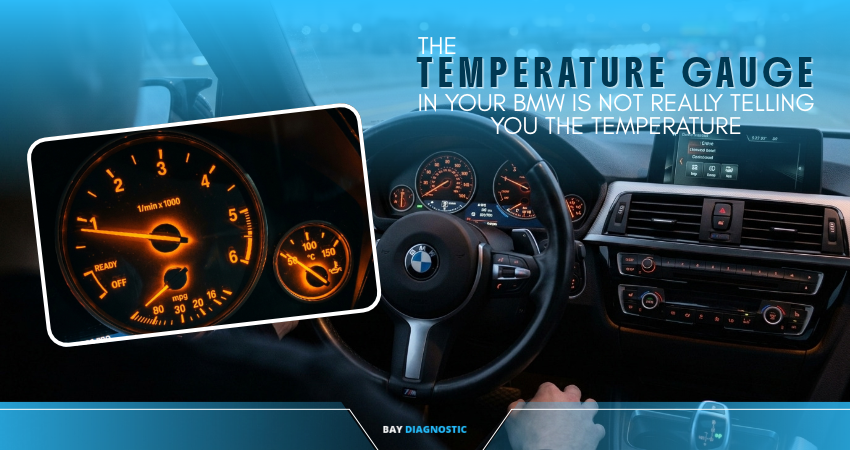
Most drivers treat the needle as a thermometer and assume that a problem would show up as a slow climb toward the red. On a modern BMW it does not work that way. The gauge is smoothed, averaged and held at center across a wide band of real coolant temperatures, so it sits exactly where it always sits until the engine is already in trouble. Then it moves fast. Owners who bring an overheated car into our shop on Gravesend Neck Road almost always say the same thing: everything looked normal a minute ago.
A gauge built to stay calm
Carmakers learned decades ago that a needle wandering with every traffic light generates service calls from people whose cars are perfectly fine. The fix was to damp the display.
Inside the instrument cluster, software takes the real sensor reading and maps a broad range of normal operating temperatures onto a single position. The needle parks at center and stays there. It is not broken and it is not lying exactly. It is reporting a category where you assumed a measurement.
What the needle is actually reading
The sensor feeding it sits in the coolant, usually near the cylinder head outlet. That matters, because it can only report on coolant that is touching it.
Lose enough coolant and the sensor ends up surrounded by air or steam instead of liquid. Air does not carry heat the way coolant does, so the sensor can read a reasonable number while the metal around it is far hotter. This is the specific failure that catches people out: a low system does not produce a gradually rising gauge, it produces a normal gauge followed by a sudden one.
The warning message comes before the needle does
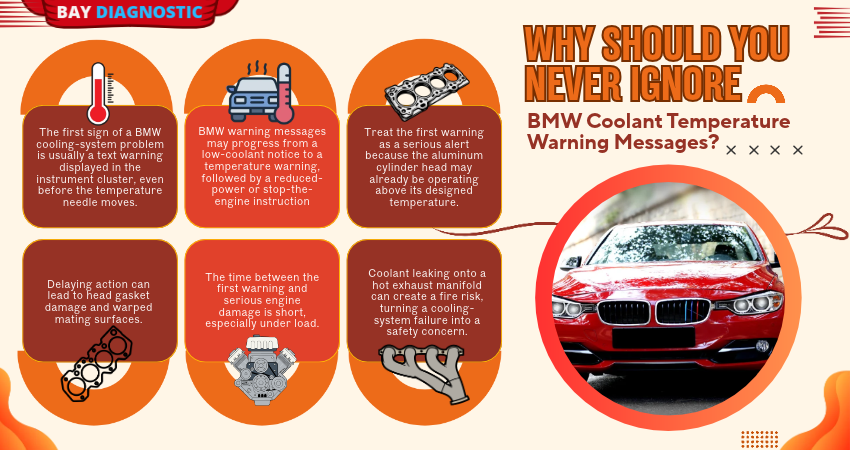
The first thing you will usually get is a text warning in the cluster. The needle may never move at all. BMW escalates these — a low-coolant notice, then a temperature warning, then a reduced-power or stop-the-engine instruction.
Treat the first one as the real alarm. By the time the car asks you to stop, the aluminum head has already been running above its design temperature, and head gaskets and warped mating surfaces are what follow. The window between the first message and real damage is short, and it closes faster under load than it does at idle.
There is a safety dimension too. The U.S. Fire Administration publishes the National Fire Protection Association’s estimate of 211,500 vehicle fires in 2024, with failure of equipment or a heat source behind 18.5 percent of them. Coolant hitting a hot exhaust manifold is one way a cooling failure stops being a mechanical problem.
Brooklyn driving hides the symptoms longer
A cooling system under light load has enormous reserve. Crawling along Ocean Parkway, the engine makes little heat and even a half-empty system can keep the gauge where it belongs.
Then you get onto the Belt Parkway, the load goes up, and the reserve evaporates. So these failures tend to land in the first few minutes of highway driving, after the stop-and-go that preceded them.
Cold weather adds its own disguise. A heater pulling hard on a December morning takes real heat out of the circuit, which flatters a system that is already marginal. The car feels fine because the cabin is warm. The cabin is warm because the engine is dumping heat it cannot otherwise get rid of.
What to do when the message appears
Pull over as soon as you safely can and shut the engine off. Running it longer to reach a better parking spot is the decision that turns a hose into a cylinder head.
Leave the hood closed until things cool down, because a pressurized system will spray scalding coolant at anyone who opens the cap. If the car has to move, it moves on a flatbed. And resist the temptation to pour cold water into a hot engine — the thermal shock can crack a head that survived the overheat itself.
Then let someone find the cause before you top it off and carry on. Coolant does not get used up. If the level dropped, it went somewhere.
Reading the real number instead
The way around a gauge that will not tell you anything is to read the sensor directly. Any scan tool that talks to the engine module will show live coolant temperature in degrees, and that number does move.
We use it on every cooling complaint, because the live reading separates problems that a gauge lumps together: a thermostat stuck open shows up as an engine that never reaches its target, a failing water pump shows as temperature that climbs with load and recovers at idle, and an air pocket shows as a reading that jumps around while the car sits still.
If your BMW has given you a low-coolant message even once, that is the moment to have the system pressure-tested. A pressure test finds the leak while it is still a leak.
Frequently Asked Questions
Q: My BMW temperature gauge never moves. Is it broken?
A: Almost certainly not. The cluster holds the needle at center across a wide band of normal temperatures by design. A scan tool will show you the actual value in degrees.
Q: Can I keep driving if the coolant warning comes on but the car feels fine?
A: No. The warning is designed to arrive before any symptom you could feel. Stop, check the level when the engine is cold, and get the leak found.
Q: How often should coolant need topping off on a healthy BMW?
A: Never, in normal service. A sealed cooling system does not consume coolant, so any repeated top-off is a leak you have not located yet.
A Pressure Test Tells You Where It Went
If your BMW has flashed a coolant or temperature message, a pressure test and a live data read will tell you exactly what is happening.
Bay Diagnostic — 1717 Gravesend Neck Rd, Brooklyn, NY 11229
baydiagnostic.com
→ Contact Bay Diagnostic