
 1717 Gravesend Neck Road,




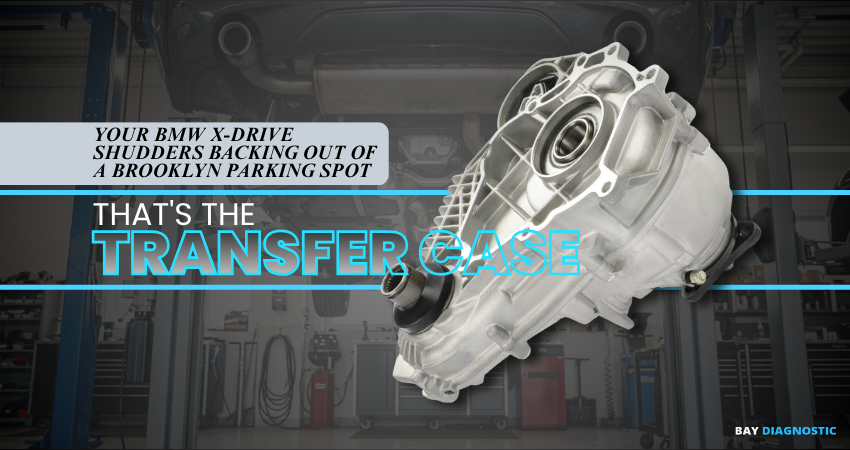
Full lock, slow speed, tight turn. The car binds, hops, then lets go with a shudder you feel through the floor. If that happens pulling out of a spot on Coney Island Avenue, stop blaming the tires. On a BMW xDrive the transfer case is the first place to look, and October is the month to deal with it.
Winter is when it earns its keep. A transfer case that already binds in a dry parking lot will be the thing that decides how your X3 or 328xi behaves on the first slushy morning on Ocean Parkway. Our Homecrest shop has been sorting all-wheel-drive complaints for over 40 years. This one arrives every autumn, without fail, in the four or five weeks between the first cold snap and the first real snow.
Quick Summary: Key Takeaways
- The classic tell: Binding, hopping or a shudder at full steering lock and walking pace points at the transfer case, not the tires or the steering.
- Actuator first: On most xDrive cases the servo motor and its plastic gears wear out before the chain or clutch pack does.
- Lifetime fluid is a label: BMW fills these cases and calls it done. A fluid service every 30,000 to 50,000 miles is what actually keeps the clutch pack alive.
- Mismatched tires matter: A worn pair on one axle forces the case to work constantly, and it will destroy a healthy unit in a season.
- Warranty on the repair: Qualifying work here is covered by a 36-month, 36,000-mile warranty.
The transfer case splits torque, and it works hardest at parking speed
An xDrive transfer case sits behind the transmission and sends power forward to the front axle through a chain and a multi-plate clutch, with an electric servo motor squeezing that clutch on demand as the wheel-speed sensors report grip changing from one corner of the car to another. Mostly it runs open. Turn the wheel to full lock in a tight space and the front and rear axles have to travel different distances, so the case must slip — and a worn one cannot. What you feel as a shudder is the driveline winding up and letting go. Nothing subtle about it.
So it shows up in a parking garage long before it shows up on the Belt Parkway.
Four symptoms Brooklyn drivers describe, in the order they appear
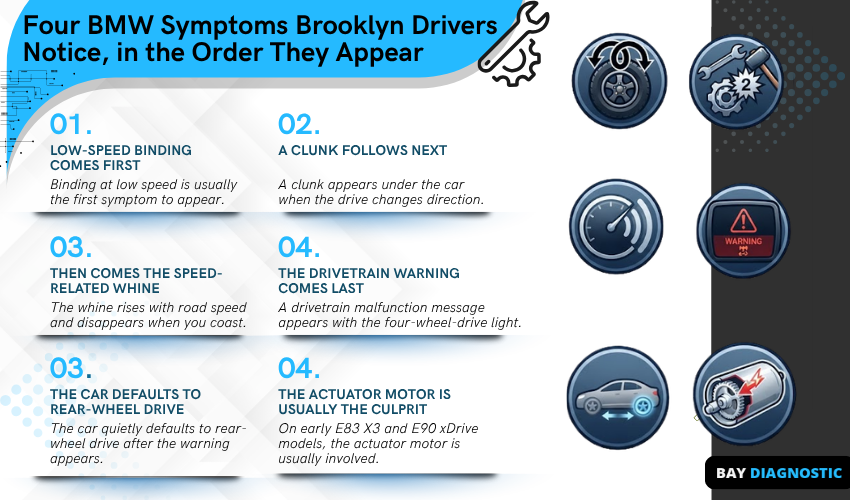
It arrives in stages. Binding at low speed comes first, then a clunk from under the middle of the car when the drive changes direction. Then a whine. It rises with road speed and disappears when you coast. Last comes the message nobody wants. Drivetrain malfunction, sometimes with the four-wheel-drive light on, and the car quietly defaulting to rear-wheel drive.
Early E83 X3 and E90 xDrive models are the frequent flyers. The actuator motor is usually where the trail ends. We have per-chassis notes on these cars because we have been working on them since they were new.
Worn actuator gears, a stretched chain and fluid nobody changed
Three failures cover nearly every case we open, and a competent inspection can tell them apart in under an hour on a lift with the right questions asked in the right order. The servo actuator’s plastic gear strips. Then the clutch never gets squeezed properly. The chain stretches. That shows up as a whine and a rattle at light throttle. Or the fluid. A few hundred millilitres of very specific oil, in there for 120,000 miles, cooked until the clutch plates glazed.
Cold weather adds a real load. The Department of Energy notes plainly that engine and transmission friction increases in cold temperatures because engine oil and other driveline fluids thicken, and that four-wheel drive uses more fuel. In Brooklyn that means the case takes its worst beating on exactly the mornings you need it most.
Ignoring the shudder spreads the damage down the driveline
A binding case never stays a case problem. Wind-up loads travel forward into the driveshaft, the front differential and the mounts, and every hard release hammers the output flange seals until they weep. We have pulled cases where the chain had already cut into the housing, which turns a repairable unit into a replacement.
Then there is the cost nobody budgets for. Constant slip destroys tires unevenly, and uneven tires then destroy the next transfer case. Break that loop early.
How the diagnosis actually gets done, on a lift and on the road
Start with tires. We measure tread depth on all four corners, because a difference of a few thirty-seconds across an axle can produce every symptom above with a perfectly good transfer case. Then the stored faults and live data get read, the actuator’s current draw is checked, and the case is inspected for seepage at the front output and the actuator housing.
A slow full-lock circle in both directions confirms it, and if the actuator turns out to be the fault, that is the whole repair rather than the beginning of a much larger one. If the actuator is the fault, that is the repair. If the fluid comes out dark and metallic, you are told before anything is ordered, and the case comes apart or gets replaced with a straight explanation of why.
Frequently Asked Questions
Q: Why does my BMW shudder when turning at low speed?
A: On an xDrive model the most common cause is a transfer case that cannot slip properly at full lock, usually because of a worn actuator or glazed clutch plates. Mismatched or badly worn tires produce the same feeling, so tread depth gets measured before any parts are quoted.
Q: How often should a BMW transfer case fluid be changed?
A: Every 30,000 to 50,000 miles, even though BMW calls the fill lifetime. It takes well under a litre of the correct oil, and it is the single cheapest thing you can do to keep the clutch pack and chain from wearing out early.
Q: Can you drive a BMW with a bad transfer case?
A: Briefly and gently. Once you get a drivetrain malfunction message the car may drop to rear-wheel drive, and continued driving with a binding case puts shock loads into the front driveshaft and differential. In a Brooklyn winter it also means you have no all-wheel drive when the roads turn.
Q: Is a transfer case the same as a differential?
A: No. The transfer case splits torque between the front and rear axles; a differential splits it between two wheels on the same axle. They fail differently and they are serviced differently, though a neglected transfer case will eventually make the front differential suffer too.
Get the all-wheel drive sorted before the first slushy morning
A shudder now is a repair. The same shudder in January, with the Belt Parkway iced over and the car refusing to send drive forward, is a tow. Drop the car at our Gravesend Neck Road shop and you will get tread measurements and stored faults before a decision is made.
Hours: Monday to Friday, 7:30 AM to 4:30 PM. Closed Saturday and Sunday.
Website: baydiagnostic.com