1717 Gravesend Neck Road,




Mercedes-Benz Coolant Leak Diagnosis and Repair in Brooklyn
Factory-Level Care Outside the Dealership
Mercedes-Benz Coolant Leak Diagnosis and Repair in Brooklyn
Factory-Level Care Outside the Dealership
A coolant leak on a Mercedes can be a slow seep that leaves a faint sweet smell after a drive or a steady drip that strands the car on the BQE. Either way, finding the actual source — rather than guessing at the most common one — is what makes the repair efficient. Bay Diagnostic on Gravesend Neck Road runs a systematic Mercedes coolant-leak diagnosis, including pressure testing and UV dye tracing when the leak isn’t obvious from a visual inspection alone.
Mercedes coolant leaks come from a longer list of places than most owners expect: thermostat housing gaskets, water pump seals, expansion tank cracks, hose connections, radiator end-tank seams, heater core lines and head gaskets on high-mileage examples. Dennis, our Mercedes-only specialist, has tracked all of them down across twenty-seven years of dedicated Mercedes work, and the diagnostic-first approach means we don’t throw a thermostat at a vehicle that actually has a cracked expansion tank.
Where Mercedes Coolant Leaks Come From
We routinely diagnose Mercedes coolant leaks originating at:
- Thermostat housing gasket and integrated coolant pipe connections
- Water pump shaft seal and housing gasket
- Expansion tank cracks — frequent on older S-Class and E-Class plastic tanks
- Upper and lower radiator hose fittings and clamp areas
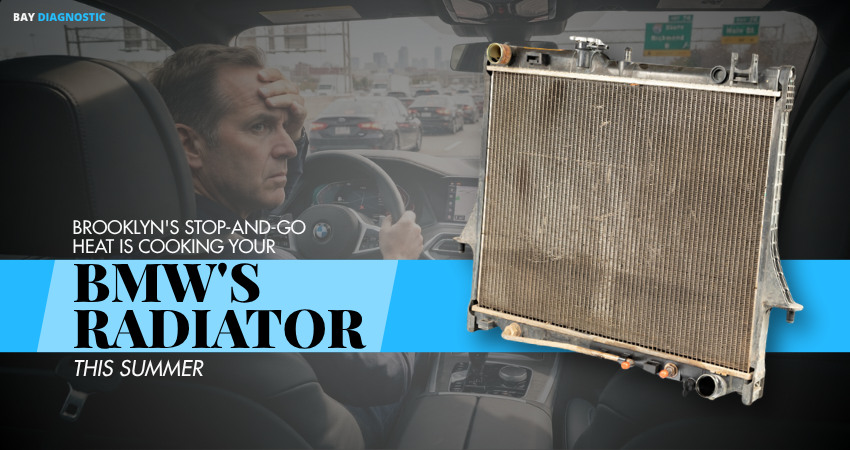
- Radiator end-tank seal failure
- Heater core supply and return — often presenting as a slow firewall leak
- Cylinder head gasket on high-mileage examples (combustion-gas test confirms)
How We Find and Fix the Leak
After a visual inspection of the hoist, the cooling system is pressure-tested with a hand pump to verify whether it actually loses pressure and where the drop occurs. Slow or intermittent leaks are traced with UV dye — coolant runs through the system, the engine is run to operating temperature, and a UV light reveals the exact point of origin.
Once the source is confirmed, the repair targets that component — a new expansion tank, a hose replacement, a thermostat housing reseal, or a water pump replacement — followed by a complete cooling-system flush, refill with Mercedes-spec coolant (the spec varies by year and engine — using the wrong color is its own fault), and a pressure retest before the car leaves the bay.
Why a Small Coolant Leak Becomes an Emergency in NYC Traffic
A Mercedes losing coolant slowly may run normally on the open Belt Parkway and overheat ten minutes later in stop-and-go on the BQE. The cooling system depends on flow through a radiator that’s only really effective at speed; once the airflow drops, a marginal coolant volume turns into a temperature spike fast. We ask owners to bring the vehicle in at the first sign of coolant smell, gauge movement, or a drop in expansion-tank level, not the tenth.





What Your Visit Looks Like
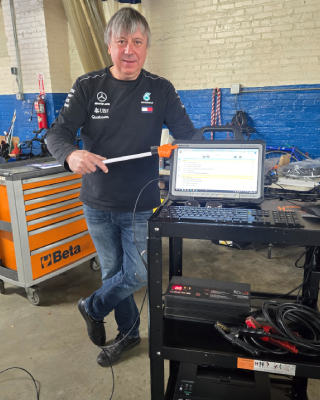
Most Mercedes coolant leak diagnoses are completed the same day. Repairs on common items — expansion tank, thermostat housing reseal, radiator hose — typically wrap in a single visit. Larger items, like a head gasket, are quoted clearly with a written timeline before any decision.
Coolant Leak Repair for
Brooklyn and NYC
Bay Diagnostic is at 1717 Gravesend Neck Road in Brooklyn, an easy drive for Mercedes owners in Bushwick, Ridgewood, and Glendale via Myrtle Avenue, Wyckoff Avenue, and the Jackie Robinson Parkway. Drivers from Manhattan, Queens, the Bronx, and Staten Island use the BQE and Belt Parkway corridors. Coolant leaks deteriorate quickly — schedule a diagnosis as soon as the level drops or you smell coolant.